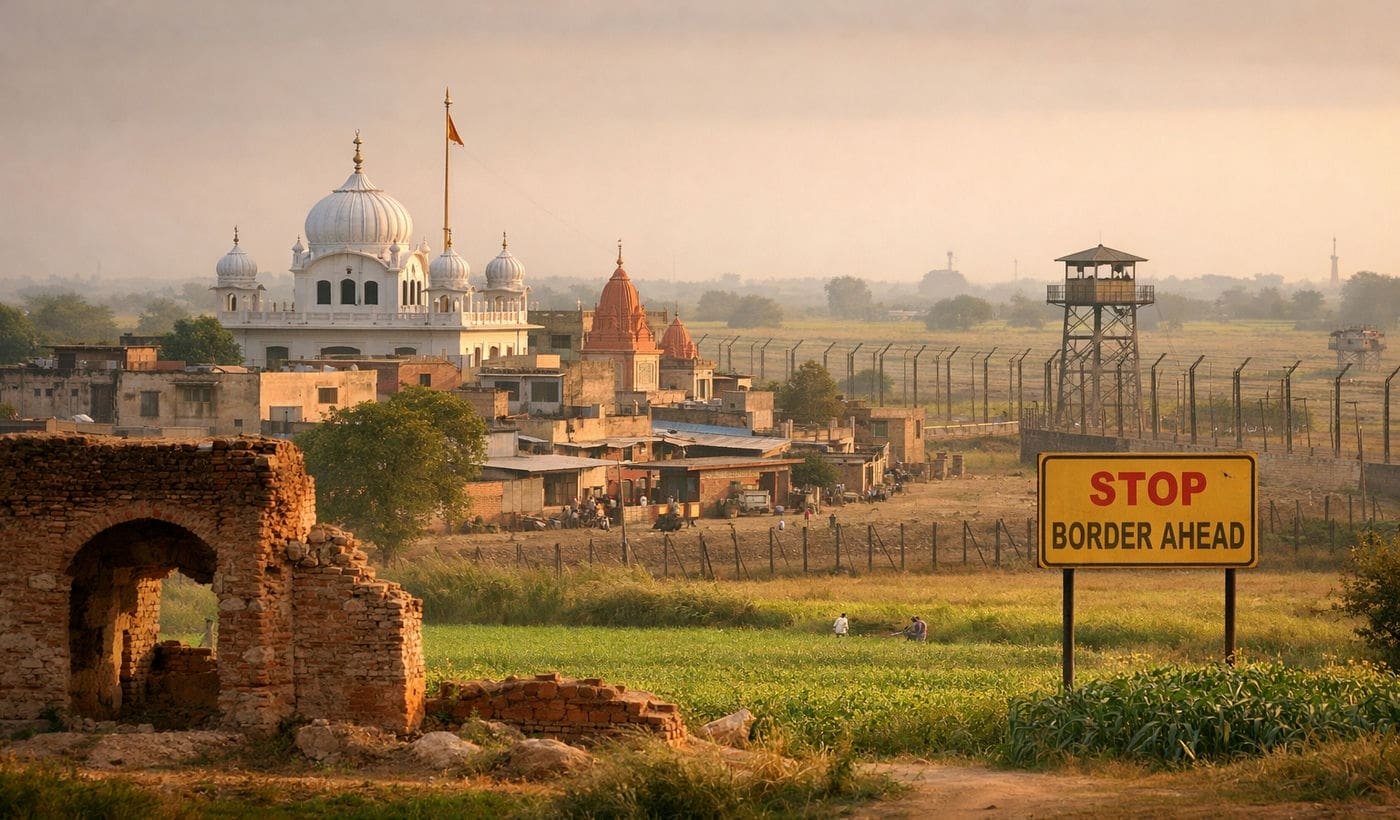
Some towns in India live quietly despite having a strong connection with history, and Bhikhiwind is one of them. It is a town and a nagar panchayat in the Majha region of Punjab, located in Tarn Taran district, about 280 kilometres from Chandigarh. The town lies close to the international border with Pakistan, and this location has shaped its life in many ways.
Bhikhiwind serves as the headquarters of the Bhikhiwind tehsil and lies about 28 kilometres west of the district headquarters of Tarn TaranSahib. The elevation here is about 214 metres above sea level. The landscape is flat. Fields stretch in every direction. The town is popularly referred to as a border city, owing to its proximity to the India-Pakistan border.
Tarn Taran district borders Amritsar in the north, Kapurthala in the east, Ferozepur in the south, and Pakistan in the west. It lies in the western end of this district, close to where India ends.
A Region Shaped by History
The region that Bhikhiwind belongs to carries deep wounds from the Partition of 1947. Communities on both sides of the new border were uprooted. Ties to the land across the line were severed overnight. What remained was a people who had to rebuild their lives from scratch on this side of a border that had not existed the year before. That trauma did not fade quickly. It passed from one generation to the next and still shapes how people in this part of Punjab understand their own identity.
Tarn Taran district itself was carved out of Amritsar district in 2006, when it was declared the 19th district of Punjab, its creation announced during the celebrations marking the martyrdom day of Guru Arjan Dev Ji. Before that, Bhikhiwind and its tehsil were part of the larger Amritsar administrative framework. The new district gave this region its own administrative identity at last.
The 1965 War and Bhikhiwind
The Battle of Asal Uttar was one of the largest tank battles fought during the Indo-Pakistani War of 1965, fought from 8 to 10 September, when the Pakistan Army thrust its tanks and infantry into Indian territory and captured the town of Khem Karan, just 5 kilometres from the international border. The Pakistani plan was bold. The 1st Armoured Division pushed an offensive towards Khem Karan with the intent to capture Amritsar and the bridge on the River Beas to Jalandhar.
Indian commanders responded with a clever trap. Indian troops flooded the sugarcane fields overnight, and the next morning the Pakistani tanks were lured inside a horseshoe-shaped defensive position. The swampy ground slowed the advance of the Pakistani tanks, and many could not move because of the muddy slush. Ninety-nine Pakistani tanks were destroyed or captured.
The Khem Karan-Bhikhiwind road was a key axis in the Pakistani advance, and it was along this route that the battle reached its decisive stage. The flat fields around this town were the stage for one of the most studied tank engagements in post-World War II military history. The battle led to the creation of Patton Nagar, also known as Patton City, at the site of the battle near Khem Karan, where the remnants of destroyed Pakistani tanks were left as a memorial.
Population of Bhikhiwind
According to the 2011 census, this town has a total population of 20,526, of which 11,038 are males and 9,488 are females, with 3,835 families residing in the town. The sex ratio of 860 females per 1,000 males is below the state average, which is a pattern seen across much of rural Punjab.
Children between the ages of 0 and 6 make up about 13 percent of the population. The child sex ratio stands at 780, notably lower than the overall sex ratio of 860. These figures reflect challenges that many small Punjab towns continue to face.
Sikhs form the dominant religious community, making up about 71 percent of the population. Hindus account for about 26.83 percent, while Muslims make up just 0.58 percent and Christians around 1.26 percent. The small Muslim presence is a direct reflection of the demographic reshaping that followed Partition. Punjabi is the language of everyday life. The culture here is unmistakably Majha, the heartland subregion of Punjab known for its martial traditions and agrarian roots.
Literacy Rate of Bhikhiwind
The literacy rate in Bhikhiwind stands at 74.4 percent, which is higher than the overall Tarn Taran district average of 67.8 percent. Male literacy is 80.06 percent and female literacy is 67.92 percent. The gap between male and female literacy reflects a broader pattern across the region. It is narrowing, but it has not closed.
The town has government schools serving students at primary and secondary levels. A government senior secondary school operates here. Residents who seek higher education typically travel to Patti, Tarn Taran Sahib, or Amritsar. The distance to these towns is manageable, but it still places a burden on students from poorer households, particularly young women.
Economy and Livelihoods
The economy of this town and the wider tehsil is deeply tied to agriculture. Wheat and rice are the main crops across the district. The flat, well-irrigated land of this belt is among the most productive in Punjab. The Green Revolution of the late 1960s transformed farming across the region, and the villages around Bhikhiwind were part of that change. Sugarcane also grows in the area, as the 1965 war accounts vividly remind us, since it was the tall cane fields that gave Indian troops their cover during the battle of Asal Uttar.
Out of the total working population of 6,846 recorded in the 2011 census, 484 were cultivators and 306 were agricultural labourers. Many others in the workforce are employed in trade, services, and small businesses that in turn depend on the rural economy surrounding the town. The tehsil’s villages form the real commercial base, and Bhikhiwind serves as the market and administrative centre for that agricultural hinterland.
The town is connected by road to Amritsar, Tarn Taran Sahib, Patti, and other parts of the district. There is no railway station in Bhikhiwind itself, and residents rely on stations in nearby towns to travel by train. Several banks operate in town, supporting farmers and small business owners with credit and savings facilities.
A Town That Carries Its History Quietly
Bhikhiwind does not advertise itself. There is no grand monument on the main road. The town gets on with the business of farming, studying, and running small enterprises.
But the history is there in the fields. It is there in the stories older residents tell about the guns that shook the ground in September 1965 and the families that arrived as strangers after 1947. Tarn Taran district has the highest percentage of Sikhs among all districts in Punjab, and Bhikhiwind is a living example of that identity, a Sikh-majority community shaped by faith, by agriculture, by sacrifice in war, and by the long shadow of a border that was drawn less than 80 years ago. That border is still just a few kilometres away. It is easy to forget that from the quiet main road of the town. But the people of Bhikhiwind have never been allowed to forget it entirely.
Also Read: Nadia District Hisory